
Project Description
Discover the Legal Copilot Project: We make hard work easy
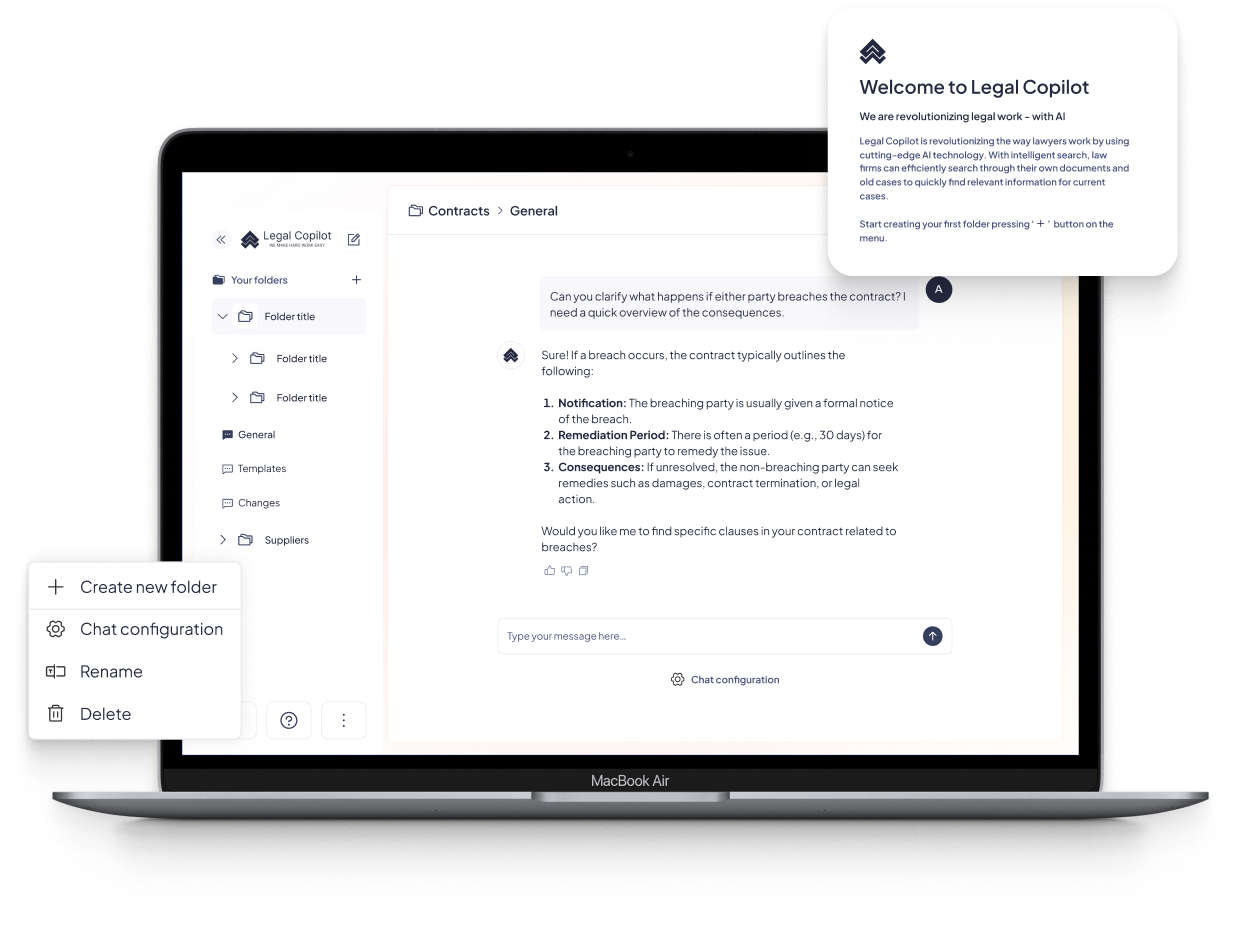
Legal Copilot is a conversational assistant developed by PTG for a law firm in Germany. Based on Artificial Intelligence technology similar to ChatGPT, this legal copilot enables legal professionals to quickly search internal documents and past cases to find relevant information, all within a private, secure environment tailored to the German legal language.
Challenges
The development of Legal Copilot presented several significant challenges. One of the main ones was processing and understanding extensive legal documents in different formats, while always ensuring legal accuracy. Another key challenge was designing AI prompts and models that minimize the risk of misinterpretations within a highly specialized legal context. It was also essential to integrate artificial intelligence into the legal workflow without compromising the confidentiality and security of sensitive information. Finally, it was important to ensure that the system’s responses were not only accurate but also structured and justified based on applicable regulations, thereby providing reliable and professional support to lawyers.
Benefits for the client and the user
Legal Copilot allows lawyers to quickly and accurately access critical information within their own documents and past cases, streamlining research and improving efficiency in legal decision-making. For the firm’s clients, this translates into faster, well-founded, and more reliable services, with a higher level of customization for each case. Moreover, by operating in a secure environment adapted to German legal language, it guarantees the necessary confidentiality and accuracy, providing both professionals and clients with a high-value, trustworthy experience in every interaction.
Technology Used
Legal Copilot is built on a set of technologies designed to deliver a secure and efficient legal assistant. Document management is handled through integration with legal databases and secure cloud storage, ensuring confidentiality and controlled access to information. For text processing, it employs entity extraction algorithms, semantic analysis, and legal summarization, ensuring precision and relevance in the results.
In terms of architecture, the backend is developed in Python, while the frontend uses React to provide an intuitive and adaptable interface. The infrastructure is based on Docker, with secure deployments that include end-to-end encryption. In addition, Legal Copilot integrates with APIs from legal databases and document management systems, enabling a smooth and reliable flow of information within the legal environment.